
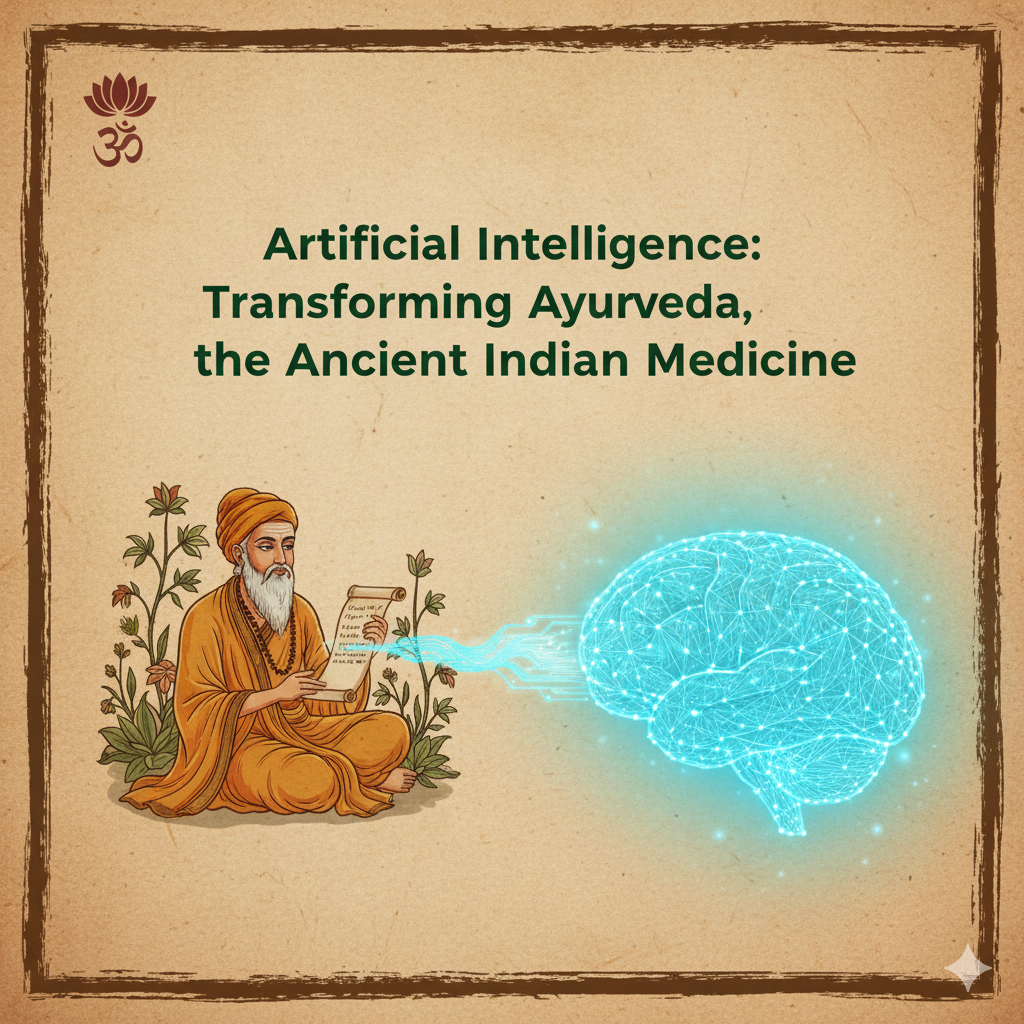
Abstract:The 21st century is a testament to technological advancement, with its tendrils reaching into nearly every facet of our lives. One area experiencing a particularly exciting transformation is healthcare, and even the ancient wisdom of Ayurveda, the “scienceof life,” is being profoundly influenced by cutting-edge technology. The powerful force behind this change is Artificial Intelligence (AI), a field that allows computers and machines to mimic human intelligence. This article delves into the potential and current applications of AI in Ayurveda, examining how this technological revolution could enhance and modernize this 5000-year-old system of medicine.Keywords: Artificial Intelligence, Ayurveda, Ancient Indian MedicineIntroductionThe Convergence of Ancient Wisdom and Modern Technology: AI’s Role in Revolutionizing Ayurveda, with its roots in the Indian subcontinent, is a holistic system of medicine that emphasizes the interconnectedness of mind, body, and spirit in achieving and maintaining optimal health (Lad, 2001). Its principles are based on the concept of doshas(biological energies), dhatus(tissues), and malas(waste products), and treatment approaches often incorporate herbal remedies, lifestyle modifications, and dietary adjustments. However, the reliance on practitioner expertise, subtle diagnostic nuances,and the time-consuming process of personalized treatment formulation pose challenges in scaling and accessibility. This is where the capabilities of AI become particularly compelling.Potential Applications of AI in AyurvedaAI offers a vast array of possibilities to augment and enhance Ayurvedic practice. Firstly, AI-powered diagnosticscan significantly improve the precision and speed of assessment. Traditional Ayurvedic diagnosis involves pulse reading, tongue analysis, and observation of physical characteristics, all of which are subjective and require considerable experience. Machinelearning algorithms, trained on vast datasets of patient information and seasoned practitioner diagnoses, can be developed to analyze these indicators with objective precision and identify patterns that might not be immediately apparent to the human eye (Agrawal et al., 2023). This can potentially lead to more accurate and earlier disease detection, enabling more effective interventions
